Finding a Light at the End of the Tunnel

CSS-NAMI Partnership Provides Valuable Peer Support

By Guy Maynard • April 18, 2026

“I’ve been in some bad moods, down and depressed or just sad or angry even. Out of curiosity, one day I decided to stop by NAMI, and I never had felt so much happiness and relief. Every time I go, I just feel lifted up. I feel like everything’s going to be OK. Yeah, I love NAMI a lot,” says Jennifer W., a CSS community member who moved from the Bertelsen Safe Spot to a mobile home a few months ago.


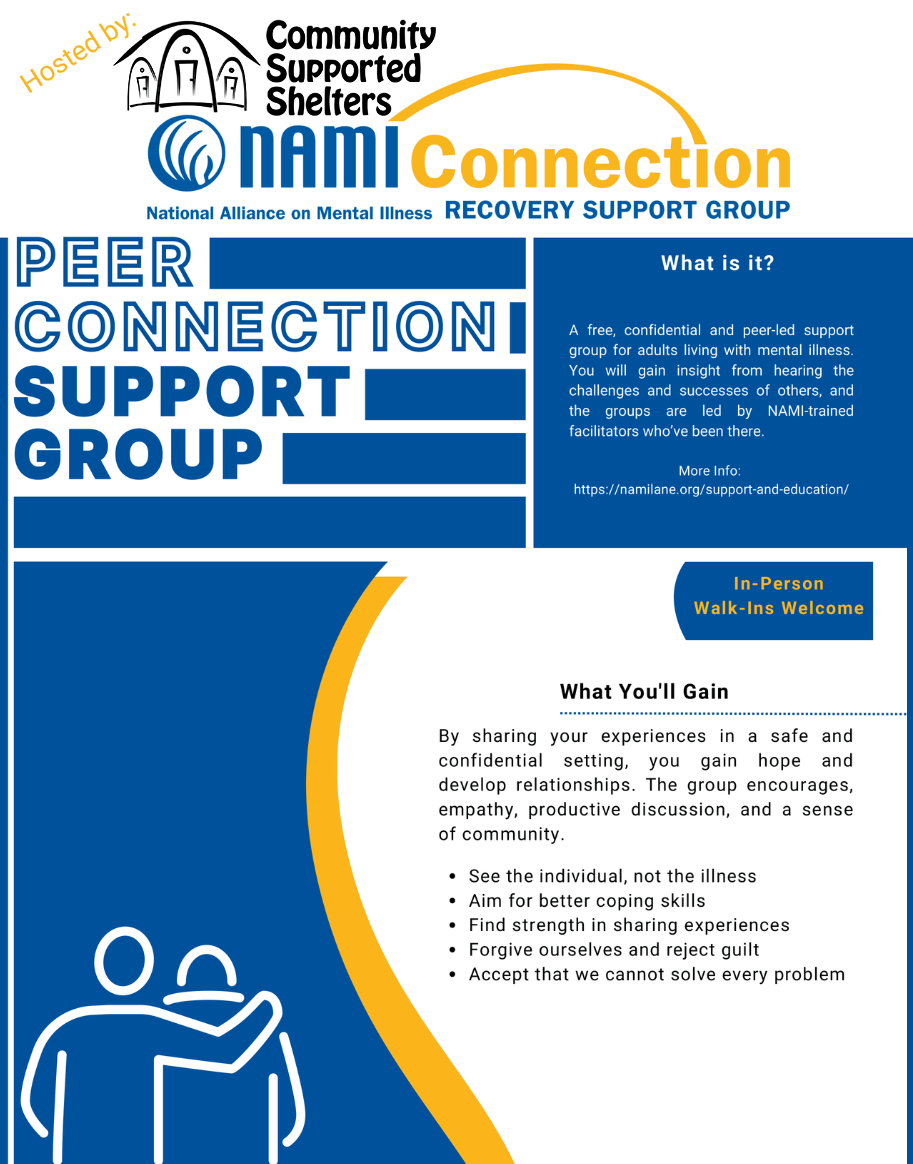
The “NAMI” she’s talking about is a peer support group that is a result of a partnership between CSS and the National Alliance on Mental Illness of Lane County. A grant from the Coquille Tribal Community Fund funded the training of two CSS staff members to lead the group and provided ongoing support from NAMI.


“I feel more like I can let what’s in me out,” says Pete, a member of the Skinner Safe Spot Community who’s been attending the NAMI group for a couple of months, “just to share what’s going on because I hold everything in a lot. It’s really helped me. If I hold everything inside, then it comes out on the wrong person or in the wrong situation. It’s a relief valve for me. I’m very happy with the staff and with the meeting. The support that I get there, it helps me keep going.”


“You’re able to hear other people and what they’re going through and dealing with and you’re not so isolated, you know what I mean?” says Amanda, who’s a member of the Lot 9 Community and has attended almost every NAMI session for the past three months. “Sometimes when you’re down and depressed, you can really isolate yourself and think ‘nobody understands me, nobody gets me.’ But in that group, you can actually go there and realize that you’re not alone and other people are dealing with the same things you are.”


Duck, a former member of the Veterans Safe Spot Community who moved into a studio apartment last October, started attending the NAMI sessions after coming upon a dead body during one of his frequent hikes exploring waterfalls. After hearing about this, MJ, CSS Aftercare Specialist, suggested he try the group to help him process the strong feelings triggered by that experience—and he’s been a regular ever since. With other organizations, he says, “if you were trying to get any kind of help, you have to go to, like, six different places to make it happen, but you can pretty much get everything done via CSS.”
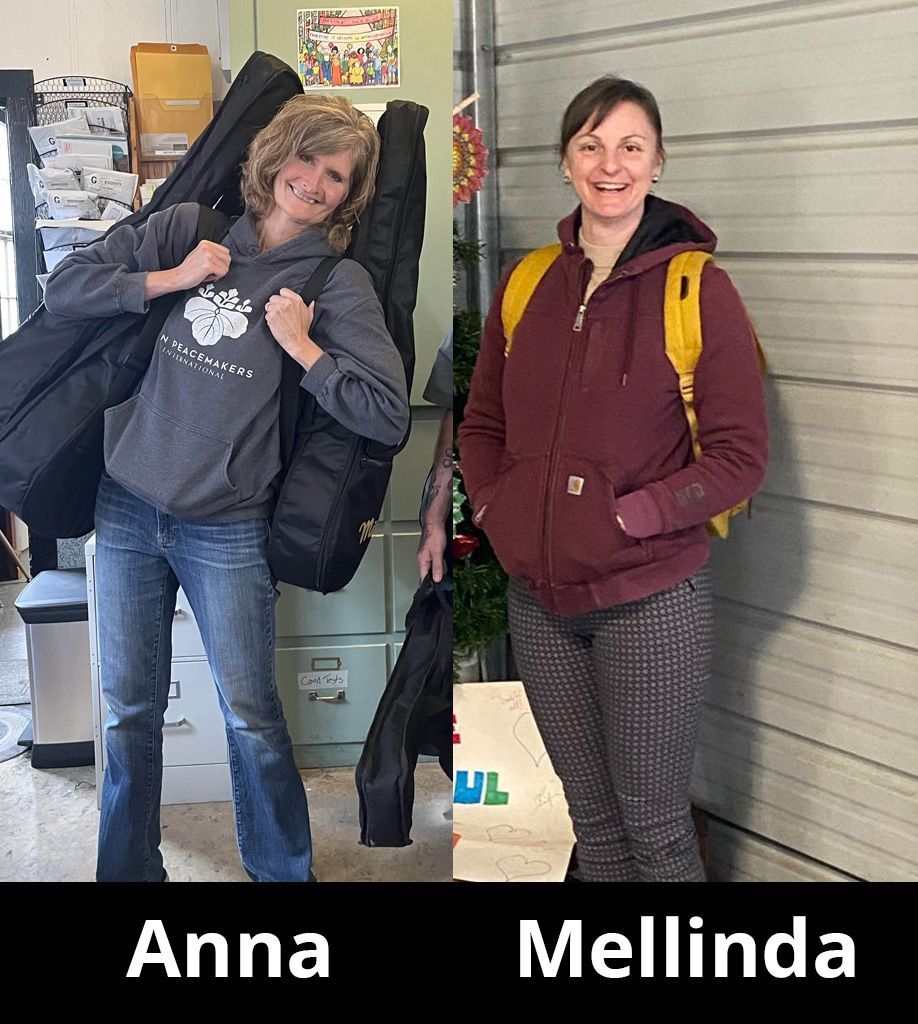

The group has been meeting every other week since July 2024, with attendance ranging from three to nine people, averaging about six per meeting. Anna, Programs Manager, and Mellinda, Service Navigation Manager, are the CSS group facilitators. 


In 2023, Mellinda suggested to Heather Quaas-Annsa, CSS Co-Executive Director, that an in-house support group was something that CSS “really needed,” and Heather followed up with discussions with NAMI and the Three Rivers Foundation.


Jennifer MacLean, executive director of NAMI of Lane County, says, in those early meetings, Heather and she realized that the “sweet spot” between the two organizations is that they “have that same philosophy of the clients we want to serve—you could be anywhere in this continuum or circle or whatever you want to call it of mental health. We want to help support you from wherever you are.”


Blake, CSS Co-Executive Director, says, “This was one of the first programs I was asked to develop at CSS. Right away, I was excited to have an opportunity to implement a program centered on an area I am deeply passionate about, mental health support.” In the spring of 2024, he asked Anna and Mellinda if they would like to hold this group, and “they said yes.” So, he worked with Jennifer to get them certified as facilitators with NAMI and develop the program offering for CSS program participants. Blake says, “It is a real opportunity for peer support and connection for people who identify with a disability status related to mental health and are also experiencing homelessness. This is the only NAMI group meeting this unique intersection of identity in our community, and I am proud of our program team’s efforts to steward this program offering—it’s a supportive and consistent community.”


The support group is based on the NAMI Connection Recovery Support Group model. The guidelines call for sessions to be led by “people with mental health conditions.” 


Anna, who says she has complex post-traumatic stress disorder, volunteered to facilitate the NAMI group. “I find that my own trauma history is precisely how I can connect to a population with multiple forms of trauma. As someone who’s not been homeless, it helps me connect in a more real way. I’ve had to work through some dicey hard feelings too, and I know what it’s like to do it badly.”


“Mellinda and I look forward to NAMI, I think, more than anything else we do, because it’s one of those rare spaces to be a peer where we get to share what’s going on with us and really be accompanied by folks who are in this population.”


Mellinda says she realized the value of the “Principles of Support” that are part of the NAMI guidelines when she attended one of the three NAMI support group sessions that are part of the training. Those twelve principles include statements such as “We will see the person first and not the illness; We reject stigma and do not tolerate discrimination; and We expect a future that is ours to shape.” 


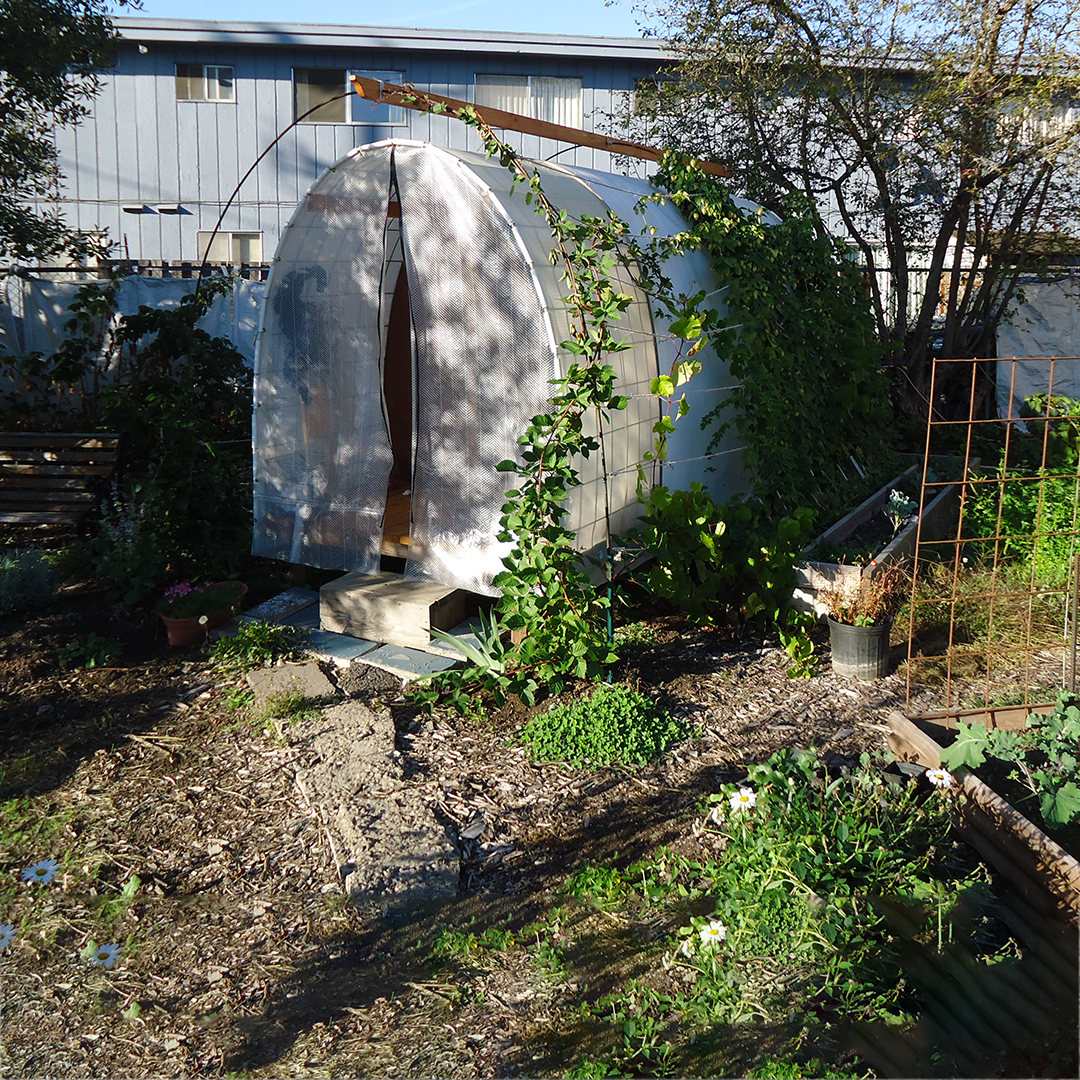
“I was talking about something that was really challenging for the facilitators to respond to,” Mellinda says, “and they said, ‘can you pick out a principle of support that you feel could help you?’ Once I picked out a principle of support that applied to my situation, we were able to have a really constructive conversation about why this principle of support applies to my situation and how I can use this as a tool to work through what I’m dealing with.” A poster with the twelve principles is on the wall of the yurt where the NAMI group meets.


Although the NAMI model focuses on mental health and disability, both Mellinda and Anna present it more as a peer support group. “This is for anybody who feels like they have something that they are struggling with and feel they need community and support,” Mellinda says. “We’re here to talk and share and be in community with one another.” 


The participants feel that sense of community. “People do a check-in,” Amanda says, “and then you open up the floor so whoever is feeling particularly down that day or had a hard week, they speak up and let everybody know what’s going on. And, as a group, we can kind of give them a little bit of feedback and just listen, actually pay attention to give somebody that time to listen to what they’re saying.” People feel heard, she says. “Absolutely, they make sure everybody gets a moment to shine.” 


Trying to find housing and work with challenging barriers can be frustrating, Jennifer W. says. “Especially when you’re just constantly being told ‘no,’ you get really discouraged. It’s so easy to just be like, ‘you know what, screw it’ and just give up. They’re there to not let you do that, basically, to give you that extra little oomph, to help you find out a different solution or a different way.”


One of the dynamics of the group is that from session to session and even within sessions, people, including the facilitators, shift roles from being someone in need of an “extra oomph” and those providing it.


“Nobody wants to always be the person that’s in need of support, right?" Mellinda says. “And nobody wants to be the person who’s always giving support and never receiving it either. I think it’s empowering for everyone involved to be able to assume both roles in that space of being the person who has the tools, who’s been through it, who has some guidance for this person and being able to feel a degree of fulfillment and satisfaction being there for somebody when they need it and having the answer that they’re looking for—and then, the reverse of knowing that there are people who care and who can help you get through it.”


“I always feel like there’s something someone has that someone at the table needs. That changes who is in need and who is giving,” Anna says. “This population starts at a deeper note, a base note, quicker because of life circumstance and pretty much a lack of pretense. So, I find myself met so honestly and well in this context that it’s not like we have to strive to be real. People walk in being quite real and it’s a wonderful thing.”


“It just helps remind you to be human,” Jennifer W. says. “To have empathy—don’t always think about yourself. Think about other people’s position every once in a while. Don’t be so quick to judge people because you never know really what’s going on in their life.”

She appreciates that the NAMI group is still available to people like her who have moved on from living in CSS communities. “It helps out a lot, too, when people first get into housing, especially by themselves, going from living in a community where you have people around you to your own apartment where you’re all alone all the time.”  


Pete says he has seen real change in people attending the group. “There’s one lady that’s had it really rough and just to see the change in her is amazing—the smiles that come out now. She still has challenges, but I’ve seen the change when she’s shared. I know what it feels like to be out there and feel alone and separated from everything, so I can identify with her. And to know how far she’s come, it kind of helps me, too.”


Amanda says the group has helped her to see “the light at the end of the tunnel.”


Duck’s only complaint is that “I would love for it to be weekly,” instead of the current biweekly schedule.


Jennifer W. would probably agree: “Those meetings have turned my aura completely around. They just brighten my day completely and it makes my week. Honestly, on the weeks that they have NAMI, I swear to God, it makes the rest of my week fly by.”


NAMI offers several similar peer support groups that are open to the community (namilane.org) but the CSS group is unique in that it is targeted specifically to CSS clients, including people living in the Safe Spot Communities, former community members who are part of the aftercare program, and unhoused people who have connected with CSS services through the Access Center.


You Gotta Nourish to Flourish

Want to support our NAMI peer-led support groups? All donations to the Community Supported Shelters Nourish Fund will be directed toward nourishing the lives of unhoused individuals through employment prep, support groups, arts entrepreneurship, and more.

Donate to Nourish Fund

News & Events

To stay connected to CSS, subscribe to our quarterly newsletter. If you are a member of the media who is seeking info, contact community@cssoregon.org.

Subscribe to Newsletter
April 19, 2026
“This is our home,” says Whitney, looking around the new 560-square foot Community Room at the CSS Roosevelt Safe Spot Community, where she lives in a Hut, “I think it really pepped up all of our moods.”
April 17, 2026
As our organization continues to grow and evolve, we’re preparing for an important transition in the year ahead. In 2026, Community Supported Shelters will close our two Communities near the Eugene Mission. This change comes as the Mission expands its Life Skills Program, an investment in services that aligns with ou
April 16, 2026
In March, we had our big fundraising concert, featuring a music project by CSS clients, staff, and volunteers! We couldn't have done it without Jason Krueger (Shanty Town band manager and bass player), Truffle Jam, Wildish Theater, Nothing Bundt Cakes, Plank Town Brewing, Springfield Public Schools, and our many in-kin
April 5, 2026
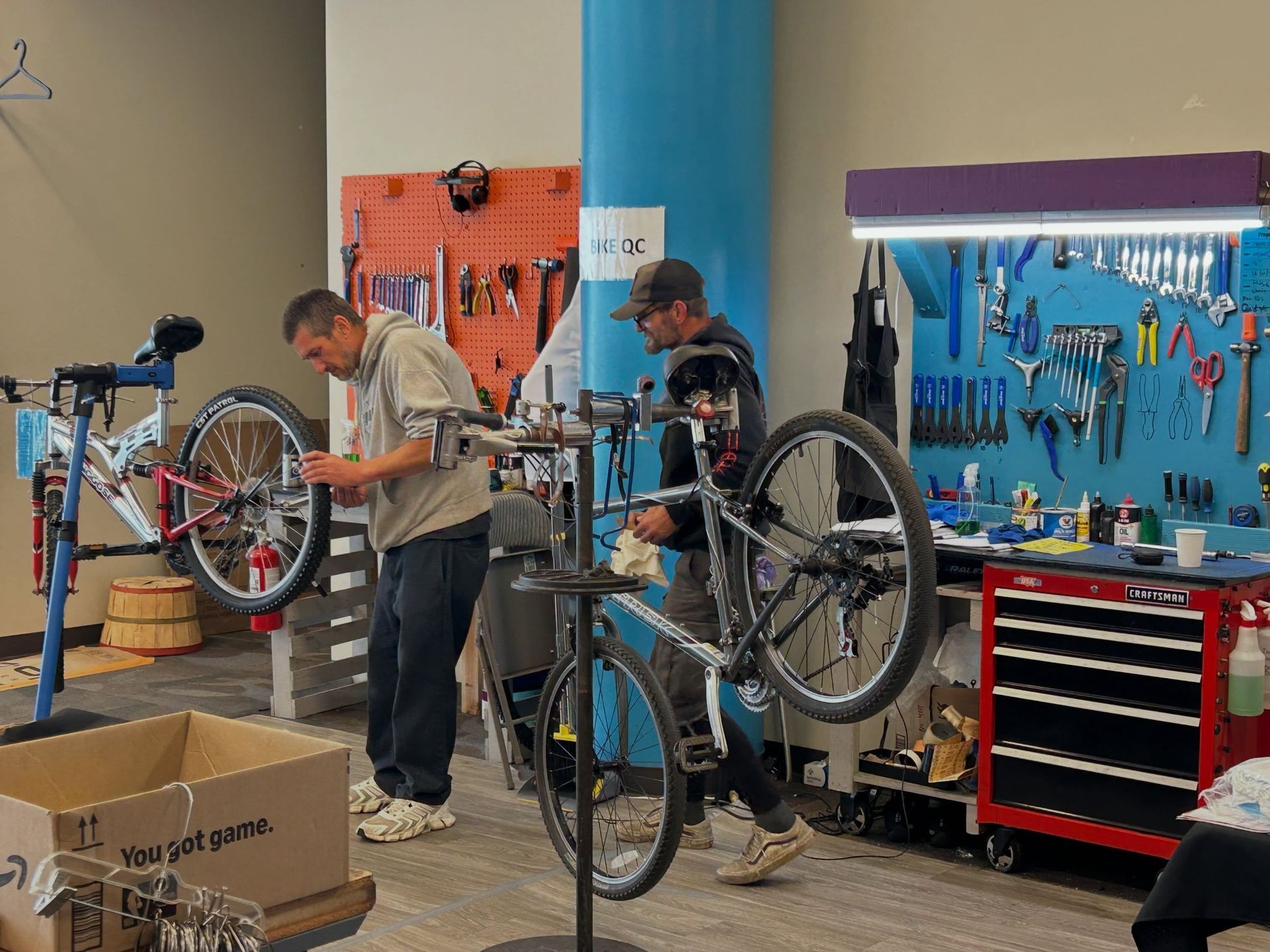
A new workforce development program in Eugene is teaching people living in shelters how to become bicycle mechanics. People like Delanya Clarkson, who came into the program with no mechanical experience. She rides bikes, but has never had the chance to learn more about how they function.
March 16, 2026
Jason Krueger has been in plenty of bands over the years: college bands in Eugene when he attended the University of Oregon, here-and-there jam sessions and Craigslist advertisement tryouts in Portland. His latest band, Shantytown, might be his most important yet.
January 24, 2026
On a sunny January day, Dan, 58, and Robert, 60, worked together on the CSS Maintenance Crew doing restoration work at the Empire Pond Safe Spot Community. Another typical workday for both of them in some ways, but one that neither could have imagined just a year and a half ago. Dan and Robert are brothers who had not
January 23, 2026
The "starving artist" stereotype is well-known. Housed folks often struggle to make an income through art. That difficulty is magnified for unhoused artists, for whom many basic resources are out of reach: good-quality supplies, studio space, and art classes. For that reason, when CSS launched our new Arts Entrepreneur
January 22, 2026
Right now is a scary time for many of the people we serve. Freezing weather brings real and immediate danger. Increased enforcement and the presence of ICE create fear and instability, particularly for immigrant community members. And harmful language and policies at the federal level continue to further criminalize ho
January 21, 2026
Major gratitude to the following local businesses: Slice Pizzeria & Bar, Claim 52 Brewing, High Street Tonics, Venue 252, Chambers Grill & Taphouse, and The Embers. Collectively, they've filled about 100 BottleDrop Blue Bags since Thanksgiving, giving us a financial boost while recycling bottles and cans.
December 30, 2025
Community Supported Shelters' new main office used to be Eugene's DMV. The building at 2870 W. 10th Place was where Eugene residents got their licenses, registered their vehicles and replaced their license plates from 1985 to 2021. Eugene's DMV is now located at 499 Valley River Center. It moved in 2022.
Show More